kuilt Help

Fair Share

Picture the shared pile of work from Warp — a roomful of devices, each grabbing jobs and putting answers back. Now add a wrinkle: the work belongs to different tenants, and they don't all deserve equal time. Team A paid for twice the share of Team B. A background export shouldn't starve someone's interactive click. You want the devices to honour those shares — Team A getting roughly twice the throughput of Team B over time — without a central scheduler, and with everyone still agreeing on who-owes-whom even after the network splits and heals.

That's fair share in one sentence: weighted turns over shared compute, with no one in charge. And, like warp, most of it is parts kuilt already had.

The pieces already ship

Each idea below is a role; underneath it is a kuilt primitive you've already met:

  • The allowance — how much compute each tenant may spend — is a BoundedCounter grown one extra dimension: instead of one shared budget, it tracks a whole tree of budgets, one per tenant edge. Every peer can merge its copy with any other and always agree, no clock, no referee.

  • Who wants work right now is an EphemeralMap — the same presence board that tracks live peers — where each device posts its own appetite and a stale entry simply ages out.

  • Whose turn is next is decided by weighted fair queuing: each tenant carries a running "virtual time," and the one furthest behind its fair share goes first. No vote, no lock.

  • Agreeing on new allowance — minting fresh budget, or re-drawing the tenant tree — rides Consensus, so two halves of a split network can never both hand out the same supply.

  • Keeping copies in step is live replication, the same anti-entropy that carries every other shared value.

How you'd use it

You bootstrap a node over a Seam with a starting allowance and a tenant tree. Every peer that starts from the same root, mint, and topology begins from an identical ledger and stays in step over the fabric. A leaf advertises appetite, a scheduling round flows allowance toward it, and then work reserves a slice, runs, and completes — completing twice charges only once:

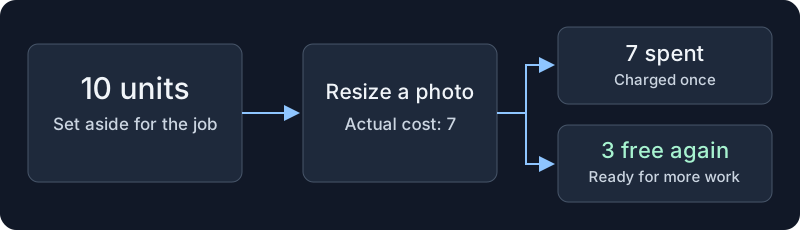
val node = heddleStatic( seam = seam, self = self, root = root, mint = mapOf(self to 100L), // this peer starts holding 100 units at the root topology = listOf(e), // root → leaf, prepared and active at bootstrap clock = { Instant.fromEpochMilliseconds(0L) }, config = HeddleConfig(policy = PolicyConfig(quantum = 10L), maxHoldingsPerPeer = 1_000L), epoch = 1L, // a persisted monotonic boot counter — bumped every restart ) // The leaf wants work; one scheduling round delegates entitlement down toward it. node.advertise(e.id, Demand(targetOutstanding = 100L, maximumUsefulGrant = 100L)) node.schedule(root) // Leaf work reserves a slice, runs, then completes — completing twice charges once. val reservation = node.reserve(leaf, maximumCost = 10L) if (reservation != null) { node.complete(reservation, actualCost = 7L) node.complete(reservation, actualCost = 7L) // idempotent no-op }

reserve sets aside a slice of the tenant's allowance so two devices can't spend the same unit; complete charges the actual cost when the work finishes. Deliver that completion once or five times — the books move exactly once.

Whose turn is next

When several tenants want the same device, the policy picks the one furthest behind its fair share. Give a child weight 3 and its sibling weight 1, start them level, and the heavier one is served first; a tenant with no appetite never competes:

// Both start level (no service yet); the heavier-weighted child has the earliest // virtual deadline, so it is served first. val grant = HeddlePolicy.pick( edges = listOf(edge("heavy", Weight.of(3), issued = 0L), edge("light", Weight.of(1), issued = 0L)), config = PolicyConfig(quantum = 6L), localHoldings = 1_000L, ) check(grant == Grant(AttachmentId("heavy"), 6L))

The policy is pure — no clock, no randomness, no floating point — so every peer, handed the same picture, picks the same winner. That determinism is what lets a scheduler run everywhere at once without a coordinator. Under the hood it is weighted fair queuing (the EEVDF discipline): each grant advances a tenant's virtual time, and the earliest virtual deadline wins.

Keeping the books

The allowance itself lives in an EntitlementLedger — the one genuinely new structure here. Budget is minted at the root, delegated down tenant edges, spent by leaf work, and released back when unused. Edges have a life cycle — prepared → active → closing → retired — so a tenant tree can be re-drawn without losing history, and an edge is only retired once its allowance has fully drained back:

// Close the edge, then try to retire it while entitlement is still outstanding — refused. ledger = ledger.piece(checkNotNull(ledger.close(e))) check(ledger.retire(e) == null) // 10 units still outstanding // Drain it (return the grant), then retire succeeds; the register now reads RETIRED. ledger = ledger.piece(checkNotNull(ledger.release(alice, e, 10L))) ledger = ledger.piece(checkNotNull(ledger.retire(e))) check(ledger.lifecycle(e) == Lifecycle.RETIRED)

Every operation conserves budget: the total minted always equals what's held plus what's been spent, on every peer, after every merge — the invariant the whole layer is built to protect.

The honest seam

Safety is a local check, not a global gate. Before a peer spends, it checks its own complete copy of the books — never a round-trip — so it can never overspend what it holds. There's also a validate() report that flags integrity problems across the merged state, but it is a diagnostic, not a safety gate: while a multi-hop transfer is still propagating it can briefly flag a phantom problem that clears itself once copies reconcile. Gate your work on the operation refusing (returning null), never on the report being empty.

The "no central boss" trick holds as long as the tenant tree is stable. Re-drawing it — moving a tenant, changing a weight — goes through Consensus so two halves of a split can't disagree on the shape; that's the heddleGoverned entry point, the governed sibling of heddleStatic above. The one accepted rough edge: if an edge is retired while a peer's still-in-flight grant hasn't caught up, that grant's budget is safely stranded rather than double-spent — recoverable later, never lost to an overspend.

The fantasy, last

The furthest-along idea ties fair share back to Warp: tag a job with a lane and it spends against that tenant's allowance, so weighted shares govern a real warp workload without warp knowing anything about entitlement —

// 2. Tag a task into a lane on the producer side. val interactive: TaskDescriptor = TaskDescriptor(op = OpId("score"), args = "doc-1".encodeToByteArray()) .inLane("acme/interactive") check(interactive.lane == Lane("acme/interactive")) // 3. An untagged task rides the default root lane and is admitted un-gated. val untagged = TaskDescriptor(op = OpId("score"), args = ByteArray(0)) check(untagged.lane == Lane.ROOT) check(admission.admit(untagged) === AdmissionTicket.NOOP)

— and, further out, jobs that say where they may run at all. A composable predicate rides the job to the mesh, and placement hashes over only the devices that qualify:

// "must run on a GPU node in us-east" — a composable predicate, not a lambda (it rides the wire). val where = Affinity.has("GPU") and Affinity.attr("region", "us-east") val gpuUsEast = CapSet(tokens = setOf("GPU"), attributes = mapOf("region" to "us-east")) val cpuUsWest = CapSet(tokens = setOf("CPU"), attributes = mapOf("region" to "us-west")) check(where.matches(gpuUsEast)) // eligible check(!where.matches(cpuUsWest)) // not eligible check(Affinity.Anywhere.matches(cpuUsWest)) // the default requires nothing

Weighted lanes and "run only where eligible" are the newest, least-settled pieces. The honest first step is exactly what ships today: a correct, conserved, coordinator-free way to give shared compute its fair turns. The full design — the ledger algebra, the fair-queue policy, the consensus seam — is written up in the design doc.

16 August 2026